
GAD therapy in Manchester and online
CBT for persistent worry and generalised anxiety
Worry can be useful when it helps us notice a problem and decide what to do. But when worry spreads across work, health, family, relationships and everyday decisions, it can start to feel as though your mind never switches off.
I am Jenny Darling, a BABCP accredited CBT psychotherapist based in South Manchester. I offer individual CBT for adults, face to face and online. My approach is collaborative, practical and focused on helping you understand what is happening in a way that makes sense to you.
When worry is difficult to switch off
People often describe trying to think their way out of uncertainty, only to end up with more questions. You may replay conversations, prepare for every possible outcome, search for reassurance or feel responsible for preventing things that might never happen.
The worry may move from one subject to another. Even when one concern settles, another quickly takes its place. This can be exhausting and can make it hard to concentrate, rest or be present with the people and activities that matter to you.
What is generalised anxiety disorder?
Generalised anxiety disorder, usually shortened to GAD, involves worry that is difficult to control and affects day to day life. The worry is often about several areas rather than one particular situation.
You do not need to arrive with a diagnosis. We can begin by looking carefully at what you are experiencing, how it affects you and what appears to keep it going.
What can GAD feel like?
Thoughts and feelings
You may find yourself expecting the worst, questioning whether you have missed something important, feeling unable to tolerate uncertainty or believing that worrying is the only way to stay prepared. Irritability, restlessness and difficulty concentrating are also common.
Physical sensations
Anxiety can bring muscle tension, disturbed sleep, tiredness, headaches, stomach discomfort, dizziness or a more noticeable heartbeat. Physical symptoms should not automatically be assumed to be anxiety, so speak to your GP if symptoms are new, severe or unexplained.
Everyday patterns
You might procrastinate because a task feels risky, avoid situations, repeatedly check information, make long lists, seek reassurance or spend large amounts of time researching possible problems. These strategies are understandable. They may help briefly, but they can also keep uncertainty feeling dangerous.
How worry can keep going
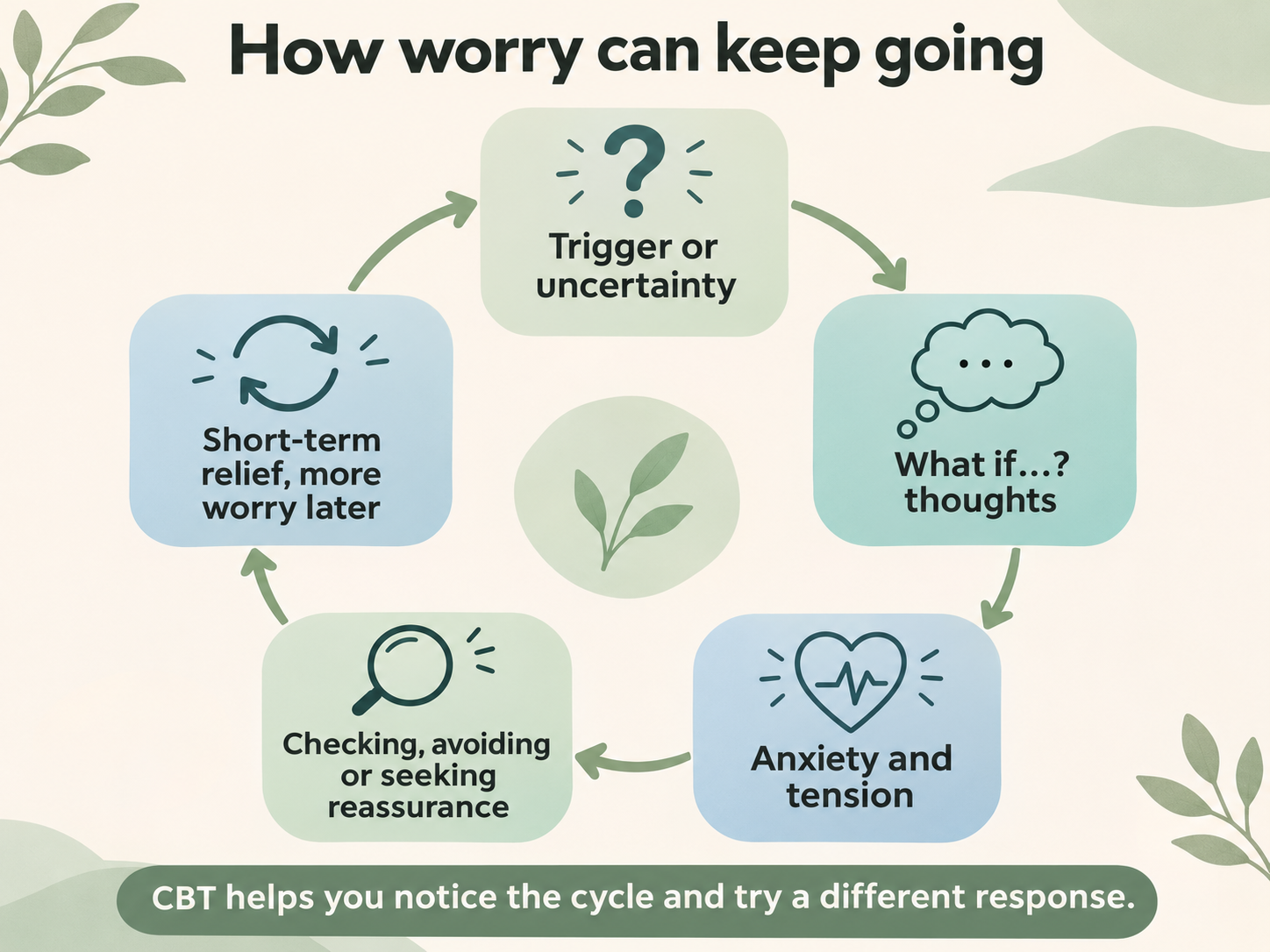
Worry often begins with a trigger or a moment of uncertainty. The mind responds with questions such as “What if something goes wrong?” Anxiety and tension increase, followed by checking, avoidance, over preparing or reassurance seeking.
Those responses may bring short term relief. The difficulty is that the brain does not get the chance to discover that uncertainty can be tolerated, so worry returns the next time something feels unclear. The diagram below shows this cycle.
How CBT for GAD can help
CBT does not try to remove every anxious thought or create complete certainty. It helps you understand the pattern between situations, thoughts, emotions, physical sensations and the things you do in response.
Understanding your pattern
We begin by developing a shared understanding of how worry works for you. This includes the themes your mind returns to, what uncertainty means to you and the strategies you use to feel safer.
Working differently with worry and uncertainty
Therapy may involve noticing when practical problem solving has turned into repetitive worry, testing beliefs about the usefulness or danger of worry and learning to respond differently to uncertainty.
Changing what keeps worry going
We may gradually reduce checking, reassurance seeking, avoidance, over preparing or repeated research. The aim is not to force you into situations before you are ready. It is to help you learn from carefully planned changes and build confidence in your ability to cope.
Building a more flexible response
CBT can also include attention training, problem solving and ways of responding to physical tension. Mindfulness may be included where it is helpful and fits your goals, but it is not used as a way of trying to suppress thoughts or guarantee calm.
What working with me is like
I have worked in mental health since 1996 across NHS services, universities, professional training and private practice. I am a BABCP accredited CBT psychotherapist, supervisor and trainer.
I explain CBT clearly and adapt the work to the person in front of me. If an explanation does not make sense, we find another way of approaching it together. Therapy is collaborative, and we review regularly whether the work feels relevant and useful.
Appointments in Manchester and online
Face to face appointments are available in South Manchester. I also offer online appointments. Sessions are for adults aged 18 and over and usually take place at a regular weekly time.
Do I need a diagnosis?
No. Many people seek CBT because worry is taking up too much time, affecting sleep, concentration or relationships, or making everyday decisions feel harder. An initial assessment helps us understand what you need and whether CBT is likely to be a suitable approach.
How long does CBT take?
The length of therapy depends on your needs, goals and progress. NICE describes high intensity CBT for GAD as often around 12 to 15 weekly sessions, with fewer or more where clinically appropriate. We would agree a plan together and review it as therapy develops.
NICE guidance on treatment for GAD →
Other routes to support
You can also speak to your GP or self refer to NHS Talking Therapies for free support. If you need urgent help for your mental health, use NHS 111 and select the mental health option. If there is an immediate risk to life, call 999 or go to A&E.
Find urgent mental health support →
Thinking about CBT for worry?
If persistent worry is affecting your life and you would like to discuss whether CBT might help, you are welcome to get in touch.
These pages provide general information and are not a substitute for individual assessment, diagnosis or emergency care.